









Other news from the world of Re:Guest
Digitalization Starts With People

What I keep seeing in conversations with hoteliers: the tool is rarely the problem. The problem is that nobody explained to the people why it even concerns them.
60 to 70 percent of all digitalization projects fail to reach their goal, or fall clearly short of it. Across industries, not just in hospitality. At the same time, current studies show: 82 percent of companies invest in new systems - but only 31 percent invest enough in cultural adaptation and employee onboarding.
That's not a random gap. That's the real reason so many projects fail.
That's not a random gap. That's the real reason so many projects fail.
The tension: we buy technology and forget the people behind it
Most digitalization projects don't fail because of the software itself. They fail because a system gets introduced without bringing along the people who have to work with it every day. A tool is bought, “set down” - and the expectation is that it will simply work.
The result: 54 percent of employees don't accept changes in change projects. In 43 percent of cases, identification with the employer even gets worse. Digitalization, which is supposed to relieve the burden, ends up breaking trust instead.
The result: 54 percent of employees don't accept changes in change projects. In 43 percent of cases, identification with the employer even gets worse. Digitalization, which is supposed to relieve the burden, ends up breaking trust instead.
“I've personally guided several PMS switches myself,” says Björn. “And what I learned from that: as soon as just the look of a system changes - not even the function - you lose people along the way if you haven't brought them on board beforehand. The technology can be perfect. If it's imposed on someone, it still loses.”
Digitalization is therefore rarely a technology topic. It's a leadership topic.
What actually makes the difference
Four success factors emerge from practice that show up again and again in successful projects:
“I'm convinced: we won't be able to do without internal AI and digitalization experts anymore,” says Björn. “Just like we needed GDPR experts a few years ago, whether people found that useful at the time or not. The question isn't whether we need this anymore - it's who takes on that role in the team.”
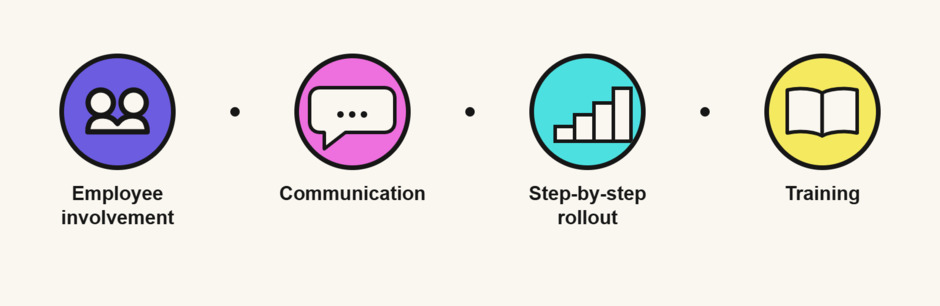
Employee involvement – involve people early, understand their needs, define processes together
Communication – don't explain what the tool can do, explain what becomes easier for the individual
Step-by-step rollout – pilot projects instead of a big bang, allow mistakes as part of the process
Training – hands-on, integrated into daily work, with fixed points of contact instead of a one-off online session
Communication – don't explain what the tool can do, explain what becomes easier for the individual
Step-by-step rollout – pilot projects instead of a big bang, allow mistakes as part of the process
Training – hands-on, integrated into daily work, with fixed points of contact instead of a one-off online session
The mindset shift: resistance isn't a problem, it's a planning variable
The most important shift in perspective: resistance to change is not an exception, and not a sign that something is going wrong. It's a logical, predictable reaction. Anyone who accepts that can factor it in from the start - instead of reacting with surprise when it shows up.
And: acceptance is not a question of age, but of mindset. Older employees aren't inherently harder to convince - young teams push back against automated processes just as much when the “why” is missing.
And: acceptance is not a question of age, but of mindset. Older employees aren't inherently harder to convince - young teams push back against automated processes just as much when the “why” is missing.
An easier way into practice
One concrete model that has proven itself in practice: not every tool has to be mandatory for everyone.
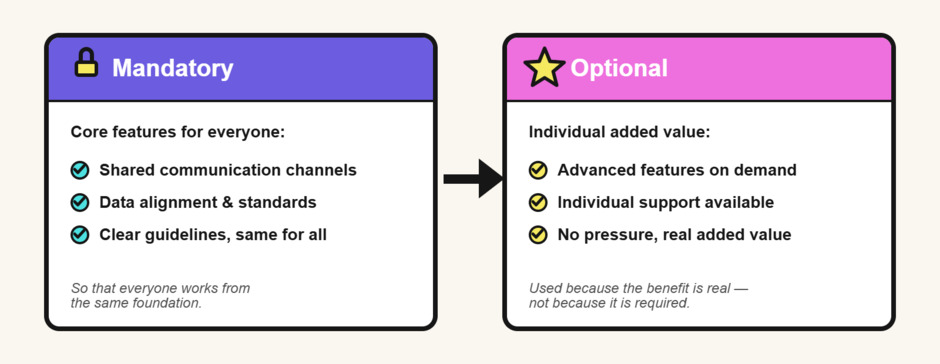
- Define a binding minimum standard for core functions that are necessary for operations (e.g. shared communication channels, standards, data syncing).
- Everything beyond that becomes optional and usable on an individual basis - with real benefits for those who want to use it.
- Important here: no artificial incentive systems that reward usage for its own sake. People keep using a tool long-term when they see the personal benefit - not because they're rewarded for it.
And one more thing that's easy to overlook - as Sascha Dahlig, Director Commercial at Signum Hospitality, points out: when teams don't get a clear, official solution, they find one themselves. That's exactly how shadow IT emerges - employees work with private tools because they don't trust the official system. That creates non-transparent processes and real compliance risks.
Where ReGuest comes in
This is exactly where the core of what Re:Guest was built for as a ComOp platform lies: not another tool imposed on hotels, but a platform that unites communication, data, and commercial processes in one system - with clear, understandable benefits for every role in the house, from the front desk team to management. Integration creates clarity. And clarity is the precondition for people to truly adopt a system, rather than just put up with it.
“In the end, it's not about whether we digitalize. It's about how we bring along the people who have to do it every day.”