Other news from the world of Re:Guest
Loyalty isn’t a points program. Loyalty is memory.

What I see in hotels again and again: hoteliers know their repeat guests by name. But many don’t know which channel those guests book through. And so they don’t know how much commission they’re paying on guests they’ve already won.
Your hotel’s best loyalty program isn’t software. Her name is Sandra, she has worked at reception for twelve years, and she knows everything: that Mr Weber wants a room far from the lift, that his wife has a gluten intolerance, that they arrive at 7 a.m. after driving through the night and would love to sit straight down to breakfast.
Then one day Sandra changes jobs. And the hotel’s memory leaves with her.
Will Mr Weber come back? Maybe. But from that moment on, to the hotel, he’s just another guest.
Then one day Sandra changes jobs. And the hotel’s memory leaves with her.
Will Mr Weber come back? Maybe. But from that moment on, to the hotel, he’s just another guest.
The tools are there. The memory isn’t.
The industry has no shortage of technology. A technology survey by the Austrian Hotel Association (ÖHV) of 294 properties shows that 69% of hotel groups and chains already work with a CRM, while among independent and family-run hotels the figure is around half. 67% automate their communication before, during and after the stay. And they invest heavily: 40% of properties spend up to €25,000 a year on digital solutions, 29% up to €50,000, and 12% up to €100,000.
For Oliver Wolf, head of Partner and Event Management at the ÖHV, the conclusion is clear: whether to use digital tools is no longer up for debate. The real question is how those tools work together – and whether there’s a clear strategy behind them.
Sandra isn’t an isolated case. In many properties, guest data is scattered – in the PMS, in Excel sheets, in staff members’ heads. And after departure, often nothing happens at all: a post-stay gap in which the relationship simply breaks off.
“Many hotels do step three before step one,” says Björn Seidel. “They choose a mechanic – points, tiers, ten percent off – before they even know what they want and who they actually have in the house.”
Yet at its core, loyalty is something very simple. Björn likes to sum up guest communication in two words: relationship management. To explain it, he draws a comparison with private life:
“Think about the relationship with your partner. By talking, I find out when their birthday is. I have to remember that. Then I have to do something with it: a dinner, a present. And the next year, again. It works exactly the same way with a guest.”
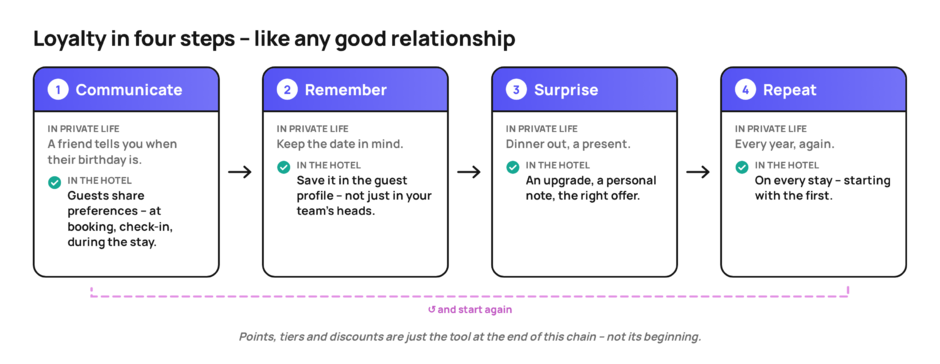
Communicate, remember, surprise, repeat. Points, tiers and discounts are just the tool at the end of this chain – not its beginning.
Three insights that show where the chain breaks
1. You know your repeat guests.
But do you know how they book?The guest is greeted by name at reception, everyone knows which room he likes, the conversation flows like between friends. And yet he books through an OTA every single time. “They know me, they greet me personally,” Björn Seidel says, describing it from the guest’s point of view. “But which channel I come through – often nobody has ever checked.”That’s more than a detail. Oliver Wolf points to the Pareto principle that applies in many hotels: around 20% of guests generate almost 80% of revenue – depending on the property, 30 to 70. At the same time, winning a new guest costs far more than winning one back. If your most valuable guests come through commission-based channels, the hotel is paying for loyalty it already has.
2. The discount that achieves nothing
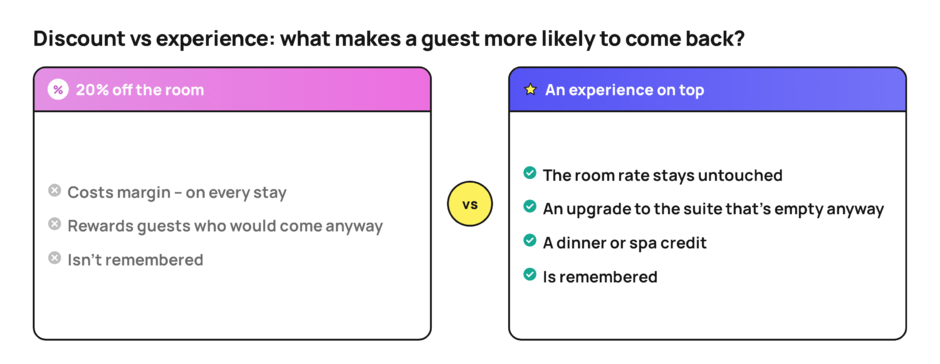
Many hotels reward repeat guests with a flat discount on the room. Björn Seidel asks an uncomfortable question: “If the guest comes for that weekend every year anyway – would he still come without the 20%? That’s the homework.”His advice: protect your margin. “Leave the room rates out of it.” Instead of cutting the room price, give added value that guests can experience: points to redeem in the restaurant or spa. An upgrade to the suite that has been empty for weeks anyway. Rico Müller, Key Account Manager Germany at Incert, cites on-top campaigns as an example: invest €100 in the menu and get an experience worth €150 – wine pairing included. An experience instead of a discount stays in the memory. A percentage doesn’t.
3. A program nobody knows about isn’t a program
Björn Seidel knows this from personal experience: his Deutsche Bahn status points had expired without him noticing. The result: no lounge access and an hour’s wait at the station. “The information was there. I just never noticed it.”Many hotels have the same problem in reverse: the program exists, but nobody mentions it at booking, in the pre-stay communication or at check-in. And even the best system doesn’t run on its own. As Rico Müller puts it: a system is no self-starter – the team has to live it. Oliver Wolf adds that it’s teamwork on site that makes the difference: what reception learns has to flow back to marketing. And when a birthday is coming up, reception and the restaurant both need to know.
Björn Seidel knows this from personal experience: his Deutsche Bahn status points had expired without him noticing. The result: no lounge access and an hour’s wait at the station. “The information was there. I just never noticed it.”Many hotels have the same problem in reverse: the program exists, but nobody mentions it at booking, in the pre-stay communication or at check-in. And even the best system doesn’t run on its own. As Rico Müller puts it: a system is no self-starter – the team has to live it. Oliver Wolf adds that it’s teamwork on site that makes the difference: what reception learns has to flow back to marketing. And when a birthday is coming up, reception and the restaurant both need to know.
The mindset shift: resistance isn't a problem, it's a planning variable
When does a guest become a repeat guest? If they come every year? Three stays in five years? Or is it about revenue? Rico Müller puts his finger on it: a guest who spends €10,000 once and one who comes ten times spending €1,000 each are two completely different repeat guests.
For Björn Seidel, this debate matters – but it isn’t the priority. “What interests me most is the guest who’s staying with us for the first time. Whether they came through the website, an OTA or a tour operator – that’s the one I want to win over. Emotionally, first of all.”
So the most important guest isn’t the repeat guest. It’s the first-time guest – the one who hasn’t come back yet. In leisure hotels especially, hardly anyone feels tied to a property. But anyone heading back to the Bavarian Forest two years later should remember exactly that hotel. Or, as Rico Müller puts it: turn the one-off guest into a repeat offender.
The next generation of guests makes this even more urgent. They grew up with games that reward every bit of progress instantly. They don’t expect to collect points for five years.They expect to be recognised from the very first stay.
In other words: memory doesn’t start on the tenth stay. It starts on the first. Anyone who only starts the communicate-remember-surprise-repeat chain for “real” repeat guests has already missed the decisive moment.
In practice: loyalty in three steps – in the right order
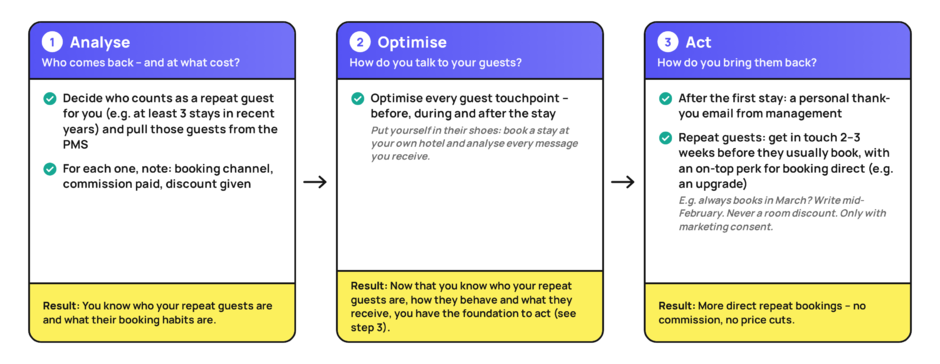
1. Analyse: one list, one afternoon. Decide what “repeat guest” means for your hotel – for example at least three stays in recent years, or a revenue threshold – and pull those guests from the PMS. For each one, note the booking channel, commission paid and any discount given. Björn Seidel: “Hoteliers are tired of hearing it. But it’s the first step.” The result is often a surprise: some of your “own” repeat guests come through commission-based channels.
2. Optimise: your communication, seen as a guest. Review all your guest touchpoints – before, during and after the stay. Oliver Wolf recommends doing it yourself: put yourself in the guest’s shoes, book a stay at your own hotel and analyse every message you receive. Too many or too few? Is all the information there? Does everything arrive at the right moment? And ask your repeat guests for their opinion too.
3. Act: two gestures, starting now. For first-time guests, a gesture that needs no system at all: Rico Müller suggests a personal thank-you email from management after the stay. For returning guests, look at when they usually book and get in touch two to three weeks before – only if they’ve given marketing consent. And instead of a room discount, offer something they can experience: an upgrade, a restaurant or spa credit.
Only then does the question of mechanics come up: CRM, communication tool, your own loyalty program. First understand who you have in the house, then choose the tool.
Where ReGuest comes in
This is exactly where ReGuest comes into the chain. ReGuest is the Commercial Operating Platform (ComOP) that brings guest communication, CRM, newsletter sending and the data foundation together in one central platform. It captures guest data and stores it in a guest profile – from the very first stay, so that knowledge of the relationship doesn’t leave the hotel when the staff do. On this basis, communication before, during and after the stay becomes something you can plan and automate: the birthday greeting, the reminder about accumulated benefits, the message shortly before the guest’s usual booking time – on the channel the guest has consented to.
Not to replace the smile at reception. But so the team has time for it again.
Not to replace the smile at reception. But so the team has time for it again.
“You already have your repeat guests. What really matters is the guest who’s here for the first time.”
There are at least 25 reasons why more than 3,860 hotels have already chosen ReGuest.
Discover the 25 reasons